Monday, April 24, 2017

WWI: Big Question

1. Why did the US get involved in WWI?

On May 7, 1915 Germany sunk a British passenger liner named Lusitania believing it was carrying munitions. It happened to be carrying both munitions and passenger and 1,198 people died, 128 of them being Americans which started tensions between the two countries. However It was not until 1917 that Wilson finally proposed joining the war believing it could be a vehicle to construct a new world order based on American Ideals.

2. What major events had shapes its readiness to participate in global issues?

The sinking of the Lusitania by the Germans, and a similar incident with a French ship named the Sussex caused tensions to grow between America and Germany.  In an intercepted telegram Germany proposed allying with Mexico to help regain their land if they went to war the US. While America had wanted to go to war Wilson prolonged America's entry until 1917.

3. How had it become prepared to participate in modern warfare overseas?

Wilson proposed a rapid expansion of the US armed forces, and had proposed a post-war order where the US would maintain peace alongside a league of nations,

4. What aspects of US involvement were the subject of debate?

The United States involvement in the war was heavily questioned by pacifists, whose pleas were heard less and less as tensions between the US and Germany began to grow.

5. For the US, what was involvement in WWI like?

The United States involvement in WWI was brief, but had a huge effect on the country. The US gained a spot on the world stage, and was able to make some of its demands reality.

6. How was the US affected by its participation in WWI?

The United States government had to have a hand in industry, agriculture, and other areas due to how taxing the war was on the economy. The economy did go through a period of economic due to all the industrial work being done, and the war caused "The Great Migration" of African Americans from the South into the North for industrial jobs. The war cost the US 32 Billion dollars, and because of how great the expenses were the US had to rely on loans from the American People or "liberty bonds" and additional taxes were introduced to help fund the war.

Thursday, April 20, 2017

WWI Posters: Second Set

Did the poster sets you reviewed accomplish the goal of the American government during this time frame or was more effort needed?

I would say that the posters definitely conveyed the message they were trying to as they used symbols and text that made everything quite clear. However, I do not know how successful they were in actually getting people to participate willingly, as women had to pick up the slack of men in various industries when they were off at war.

1. All the posters feature bleak backgrounds with darkness as well as looming figures to make the posters seem ominous, and drive home the message of an impending threat. The threat in the first image being the conflict on the horizon shown by the billowing smoke, the "Mad Brute" with a German helmet was meant to represent the Germans in the second image, and the "Hun" or German with bloodied hands and bayonet. The brute is scary and crazy looking and has a bloodied bat labeled "culture" to instill fear. The Hun soaked in blood is done similarly to instill fear. America is also featured in the first two images, represented by a sleeping lady liberty in the first, and the word "America" written on the soil in the second.   Images


2. The posters have clear directives. The first addresses "Every man, women, and child!" to wake up and do the part, the second calls upon men to "Enlist" to push back the Germans or "Mad Brute," and the final one is directed at people on the homefront says to back the army by purchasing liberty bonds. As I said earlier the posters were meant to instill a sense of fear and urgency in the demographics targeted to convince them to do their part.

3. The ideal target audience for poster one is "Every man woman and child!" You can tell because it says so clearly at the bottom. The second poster is targeted at men because it is calling upon them to enlist in the army, and also features a damsel in distress to further hammer the point home. The final is directed at those on the homefront who cannot participate in the war for some reason, and it is asking them to support through the use of "Liberty Bonds."


Wednesday, April 19, 2017

WWI Poster

Propaganda

1. Any material or media created for the sole purpose of influencing peoples decisions or views on something, typically politics.

2. Definition of Propaganda(As provided by Dictionary.com)


Images

3. The images all depict woman practicing various trades in the army. The first two show women as nurses and the second shows a lady running a switchboard. Both of the nurses are featured prominently, one with a hand reaching out, and another welcoming the viewer into a doorway. The text is also rather large to make it more noticanle and catch the readers eye. That way if the image doesn't speak to them the text surely will.   . Images 

4. All the posters feature women doing tasks to show that woman also have a place in the war beside men. Whether it is as a nurse or switchboard manager. They hoped to persuade the women that they have a part in the war as well, and that the men are not the only one with a duty to their country.

5. All the posters are targeted at women, and you can tell because they all only feature women. The first asks women to aid by joining the Red Cross, the second clearly outlines the opportunities available to women who pursue nursing in the war, and the third asks the women to join the force and "back our girls."

6.  I don't really mind the government using tax dollars to pay for propaganda as I am perfectly capable of making decisions without the government's influence. On the other hand it could convince less rational thinking people of something that isn't true which could present a concern. Overall I am not that bothered by it though.

7. The government most likely wanted to make the war seem much more glorious that what it was in an effort to get people to join. While war was typically romanticized most people probably would not be happy going to war, so the ads would persuade the uneasy or undecided.


Thursday, February 9, 2017

Progressive Post

     While I do not believe we have complete control over the future, I do believe we can influence it heavily. The future is largely controlled by the people and what they want. In theory, the government is supposed to regulate a state, and acts as an extension of the peoples will. While that is not always the case in an ideal democracy the government should largely be under the control of the people. There are times in history when the government has had to step in, or do things that might alienate or go against the will of a large group of people, and when these things happen there is typically a response of backlash. Examples of this being the progression of the civil rights movement. Which started with the clashing ideals of northerners and southerners over slave labor. The civil war happened as a result and the Union victory resulted in the emancipation of slaves all over the US. African Americans had to fight for basic human rights for hundreds of years, but finally achieved their goal after many protests, sit-ins, and demonstrations. I believe the future can be affected if the will of the people demands it.

Progressivism: Sci-Fi Predictions about the 21st Century

1. It seems as though a lot of science fiction authors in the 20th century were able to predict the future as many of the ideas they thought of became reality. H.G. Wells predicted a lot of the creations of the nuclear age in his book The World Set Free, George Orwell predicted the age of heightened surveillance, and Fahrenheit 451 predicted things like virtual reality and a society absorbed by the media.

2. I don't believe any of the authors intended for the events of their novels to transpire. Most of them since 1984 and Fahrenheit 451 were written out of their authors perceived grievances in the world around them. They were more cautionary tales than hopes for the future.

3. I believe that 1984 did predict the level of surveillance and censorship that occurs in the modern world. Especially with the controversy around net neutrality and government surveillance. Fahrenheit 451 also predicted a society caught up with the media. While these things aren't taken to the extreme as they are in the books, they still occur now to some extent.

4. It seemed like most of the authors were predicting that society would be reduced to dystopias, but none of their imagined realities were positive.

5. I believe in the future we will probably have a better handle on interplanetary travel, and will have colonized Mars, or started to. I also think that virtual reality, augmented reality, and things of that nature will play a big part in the future of technology.


http://www.businessinsider.com/books-that-predicted-the-future-2013-9

http://mashable.com/2014/07/23/sci-fi-books-the-future/#CFUhH5I_WGqV

Monday, February 6, 2017

Henry Ford and the Ford Model T

Ford Model T Sedan
        While the Ford Model T was not the first automobile it is definitely the most iconic, and had a profound effect on industrialism and urbanization in America. The Model T was the first commercially successful car sold by the Ford Motor Company from 1908-1927, and was the most common automobile in the United States while it was produced. It provided a new form of transportation, and was the first automobile to be adopted by the masses. With the use of new manufacturing techniques, and the rising consumerism in America the Ford Model T was able to be successful, and made automobiles something that working and middle class Americans could afford. The Ford Model T was successful not only because of its time and place, but because of the measures taken to make this car the most accessible one to date.
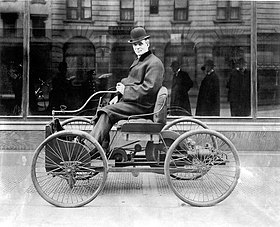
Ford and his Quadricycle

        The Ford Model T was not the first vehicle built by Henry Ford, and there were many advancements that lead to its eventual success. The first motor vehicle built by Ford was the Quadricycle, which Henry Ford himself built in his workshop in Detroit while working at Edison Illuminating Company. After his invention he would leave the Edison Company to pursue the automobile industry, but experienced a series of failures with the Detroit Automobile Company, and the Henry Ford Company, until he formed the Ford Motor Company in 1903.  The Ford Motor company was valued at 2 million when they unveiled the Model T. At release the Ford Model T was $850 and came in six different colors. The release of the Ford Model T put Ford Motor Company on the map, and made Ford a household name.
Model T converted into Fire Truck
Ford Model T Speedster
        The Ford Model T was the perfect car for early 20th century America for many reasons, mainly because of how it was built. It was one of the first automobiles with interchangeable parts, making it easy to service and maintain. Many companies also sold kits for  users to customize the Model T to their heart's content. Many Model Ts were converted into things like tractors, fire engines, and race cars. It handled the unpaved, rough, pre-urbanization dirt roads of America well, making it perfect for the farms, country roads, and small towns of rural America. Ford was also able to decrease its price significantly with many slight changes, the most notable one being a new method of manufacturing called the assembly line in 1913. The assembly line allowed Ford to bring the $800 price tag down to $325 making it more affordable than ever. By bringing the price down considerably, and making the car suited for almost any terrain the Model T was the perfect car for the century.
        The  introduction of the automobile by Ford lead to significant strides in the urbanization of America, and the reshaping of the United States landscape. New forms of transportation were being experimented with, but none would have the impact of the automobile. With the automobile becoming apart of mainstream America, efforts were made to make the roads more suitable for drivers. Concrete and gravel highways became the standard in the United States with many businesses and attractions popping up along these new roads. The boom in the auto industry lead to booms in the petroleum industry, and in the rubber industry due to tire production. It also changed the industrial scene with its use of the assembly line making production easier and more efficient. Though the Model T was just a car it had a great impact on urbanization and industrialism in the 20th century.
       I believe the Model Ts success can be attributed to the time of its release. It came at a time when innovation was needed in transportation. People living in cities required new forms of transportation to get around the new urban areas. The economy was reaching a point where people were finally willing to spend money, and consumerism was on the rise. The Ford Model T was the first vehicle that made automobiles a non-luxury item that the average consumer could afford. This perfect timing allowed it prosper.
2017 Ford GT

        The Model T may not have been the first automobile, but it was definitely the most influential. It popularized the left-sided steering wheel, and made installment plans a standard in automobile sales. The assembly line created in 1913 is also still widely used today in the automobile industry, and cars are now something that almost anyone can afford. The automobile industry would not be where it was today without the Ford Model T, and its legacy is still present today.

Works Cited:


"Henry Ford: Motorizing America." American History, ABC-CLIO, 2017, americanhistory.abc-clio.com.  Accessed 01 Feb. 2017.
Shumsky, Neil Larry. "Automobiles." American History, ABC-CLIO, 2017, americanhistory.abc-clio.com. Accessed 01 Feb. 2017.
McGuire, William, and Leslie Wheeler. "Henry Ford." American History, ABC-CLIO, 2017, americanhistory.abc-clio.com. Accessed 6 Feb. 2017.
Dearborn. "Model T Facts." Model T Facts. The Ford Motor Company, 05 Aug. 2012. Web. 01 Feb. 2017. <https://media.ford.com/content/fordmedia/fna/us/en/news/2013/08/05/model-t-facts.html>.
"Ford Motor Company Unveils the Model T." History.com. A&E Television Networks, n.d. Web. 01 Feb. 2017. <http://www.history.com/this-day-in-history/ford-motor-company-unveils-the-model-t>.
"Model T Variations." The New York Times. The New York Times, 19 July 2008. Web. 01 Feb. 2017. <http://www.nytimes.com/slideshow/2008/07/20/automobiles/collectibles/0720-MODELT_index.html>.

"SIX CYLINDER CAR FEATURE OF SHOWS." New York Times 13 Oct. 1907: n. pag. NYtimes.com. The New York Times, 13 Oct. 1907. Web. 01 Feb. 2017. <http://query.nytimes.com/mem/archive-free/pdf?res=9F05E2DF173EE233A25750C1A9669D946697D6CF>.

Tuesday, December 13, 2016

The Ghost Ship Fire Incident

       
       The Oakland Ghost Ship fire was a devastating fire incident that occurred at a warehouse called the Ghost Ship in Oakland, California. On December 2, a warehouse in Oakland, CA known as the Ghost Ship burst into flames during an electronic music concert taking the lives of 36 people. 

Many factors reduced the number of survivors, one being that there was no direct route from the stairs to the exit. The front stairway, which was built by the residence, lead into an open space with no direct root. After making it downstairs people then had make their way on the circuitous path to the doorway around pianos and furniture in a very enclosed space. According to resident Carmen Brito the Ghost Ship would have been very hard to navigate for people who did not live there. The Ghost Ship was not safe, and did not mean structural standards. There were propane tanks used to heat water near piles of flammable debris as well as an old electrical system that did not work, and constantly sparked. Rats also posed a problem, but were most likely not the cause of the fire. It has been determined that the fire was mostly caused by the buildings faulty power grid.
       This Ghost Ship fire has many similarities to the Triangle Factory Fire that happened in New York in 1911. On March 25, 1911 a fire consumed the Triangle Shirtwaist Factory taking the lives of 146 people. This incident was largely the result of poor working conditions and inadequate fire safety precautions that were taken during the time. The owners of the factory locked the exit doors believing that their business would suffer if their workers tried to steal from the factory. The only other exit was the fire escape which could not bear the weight of all the workers, and was not a viable escape route. Which is similar to the lack of escape routes in the Ghost Ship incident, and raises the question: are the proper fire safety precautions being taken with buildings today?

Sources:
  1. http://www.nytimes.com/interactive/2016/12/12/us/oakland-warehouse-ghost-ship-fire.html
  2. http://www.nytimes.com/2016/12/08/us/the-oakland-fire-delving-into-what-happened-and-why.html
  3. http://www.nytimes.com/2016/12/11/us/the-oakland-fire-what-we-know-about-the-warehouse-owner.html
  4. https://trianglefire.ilr.cornell.edu/story/sweatshopsStrikes.html

Tuesday, November 22, 2016

The Assimilation of Other Cultures in America

America has a long history of assimilating foreign cultures into society, and the 1800s the US government began the the process of assimilating Native Americans into America. They did this through the use of the education system, and by giving the Native Americans land to begin anew and become a part of society. In 1879, Congress created boarding schools for Native Americans, and started forcing the children of Native Americans into these schools where they were unable to practice their Native American traditions. While it was optional, most Native Americans did it because those living on reservations were denied rations otherwise, which essentially forced them to send away their children. The government hoped to rid the Native Americans children of their  culture by forcing them into an environment where their beliefs and culture were shunned. The govenrments given explanation was that it was a better alternative to "shooting indians".

https://americanhistory.abc-clio.com/Search/Display/1700117?terms=assimilation+of+native+americans&sType=quick

https://americanhistory.abc-clio.com/Search/Display/1699303?terms=assimilation+of+native+americans&sType=quick

https://americanhistory.abc-clio.com/Search/Display/1690402?terms=assimilation+of+native+americans&sType=quick

Friday, November 11, 2016

USH In Class Assignment

https://archive.org/stream/conciseschoolhis02camp#page/n21/mode/2up

1.

2. Today we looked at a history textbook from 1887, and read a selection of pages talking about Native Americans during the 1600s. We did this to see what conclusions someone in school might have drawn from these textbooks in the late 1800s, and how it might have shaped their views of Native Americans.


3. If I were a student reading this textbook in the late 1800s I think this textbook would definitely have changed my view of Native Americans. The textbook calls them vengeful and states that they considered war to be "the most honorable employment,"  and that, "the one who could show the greatest number of scalps, torn from his foes, was considered the bravest warrior." These quotes make it seem like the Native Americans were warmongers, when in reality they were no more aggressive than the Europeans who colonized their land. The textbook even goes as far as to use the word "savage" interchangeably with Indian as if the terms are synonymous with each other dehumanizing them. So it would probably give me a bad impression about Native Americans.

Tuesday, November 1, 2016

Letters from the West


http://postalmuseum.si.edu/exhibits/current/binding-the-nation/moving-west/your-letters-are-read-with-eagerness/waterman-ormsbys-letter.html
1) What was this letter(s) about?
The letter was about a man who had recently purchased land in the West, and was writing for his wife and child. He sent this to his wife to inform her about his ventures in the West, and what he expected them to do in the following year. He told her that he had selected 160 acres of land as well to other plots in case that one didn’t pan out. The man told his wife that while the land is beautiful it does have its fair share of issues, but that they will be able to start a life, and live in a house made of sod that is as just as good as any other house. He later finds out that the land he had procured had been taken up by some others, but that he intended to get it back.
2) What stood out to you in the letter?
The letter didn’t really pay much attention to grammar, and was mostly just a man telling his wife about his initial feelings of the West.
3) How important was the act of letter writing at this point in time to people migrating West? What did it mean to them or their loved ones?
The act of writing a letter while migrating to the West was very important because it allowed settlers to communicate with those they left at home. It was the only means of communication with those in the West, so maintaining a correspondence with loved ones was important because it offered settlers a connection to those in the East.


Wednesday, September 28, 2016

Learning History Through Film


While Glory and Twelve Years a Slave are not completely accurate they still provide a great platform for learning about history because of their visual medium. Film being the visual medium that it is, allows the audience to see and experience what the main character or characters are experiencing by not just telling, but showing. Film can also give audiences more context about the setting not just through visuals, but through sound and music. Watching 12 Years a Slave provides a far different experience than reading it because we have to watch Solomon struggle. Seeing the  While both Glory and Twelve Years a Slave may alter the source material, it does not alter it to the point where it is unrecognizable. Both films add a little fiction to make the stories more appealing or engaging for film audiences, but while some of the material may be false, it is ultimately overshadowed by what the films get right.

Glory is a Civil War movie that tells the story of Robert Shaw and how he leads the first African American regiments. It is based on letters written by Shaw, and many of the characters in the movie are real people like his best friends Thomas and Ford. The movie does add in fictional characters like those played by Denzel Washington and Morgan Freeman, but they are there to pose questions to the audience, and help further the story. In Glory we get a glimpse of what it is like for a character like Thomas, a free African American, to interact with others in the regiment who have fled from slavery. Denzel’s character Tripp constantly gets into fights with Thomas because he believes Thomas is delusional for thinking he can “be like the white man.” Films like Glory can show us not only the dynamic within the troops, but also between a Colonel and his soldiers. Brodericks scene with Washington’s helps illustrate the racial dynamics at play. When Shaw asks Tripp why he refuses to carry the flag, Tripp responds saying when the war is over Shaw gets to go home, but where does he go? Movies can show the audience different perspectives through the eyes of characters from all walks of life. The film also uses music from the time, proper weapons, and period accurate uniforms. Glory adds in fictional characters, but depicts both the setting and strategies of the Civil War extremely well. Films like Glory teach more than any textbook ever could because of all the different ways it immerses the audience.

Twelve Years a Slave takes place in the Old South, and showcases what slavery was like in the 1800s. The film gives an interesting perspective on slavery by showing it to us through the eyes of Solomon Northup a freeman turned slave. It shows what his life was like both before to humanize him, so that when he is captured we experience the jarring shift with him.  The audience is not  just told about Solomon’s suffering, they are forced to watch every experience from the whipping to the hanging. A fairly accurate recreation of a slave market is also shown when Solomon is sold off. The film does not take sides, and shows how slavery was not one dimensional. Ford clearly tries to keep families together, and recognizes the cruelty of slavery, but he also has to pay off his debts and slave labor is his cheapest way of doing it. Epps is a far crueler owner, and obviously has no problems with slavery. While some of the scenes like the boat scene, and the scene in which Patsey asks Solomon to kill her are not completely factual, they do not detract from the vast amount of information the film gets right. Twelve Years a Slave is one of the few films that actually focuses on slavery, and it paints a realistic picture of what slavery is like.
While filmmakers tend to take some creative liberties with historical films, they still are one of the few mediums where you can get to see what was happening. Photographs can give can give you an idea, but films put you in the moment. No other form of media employs more elements than film, and  it is for that reason that it is a great platform for learning about history.


Works Cited
The Atlantic. Atlantic Media Company, n.d. Web. 27 Sept. 2016.
Canby, Vincent. "Review/Film; Black Combat Bravery in the Civil War." The New York Times. The New York Times, 13 Dec. 1989. Web. 27 Sept. 2016.
Dargis, Manohla. "The Blood and Tears, Not the Magnolias." The New York Times. The New York Times, 17 Oct. 2013. Web. 27 Sept. 2016.
Ebert, Roger. "Glory Movie Review & Film Summary (1989) | Roger Ebert." All Content. Freddie Fields, 12 Jan. 1990. Web. 27 Sept. 2016.


Thursday, September 8, 2016

Paraphasing 12 Years a Slave Review

Of course the language and violence in 12 Years a Slave makes you wince, but the brutality here is as sleek as a knitting needle, and slips between your ribs to get at you somewhere deep, beyond simple expressions of disgust or disbelief. McQueen has no intention of turning his film into a Western liberal guilt-trip — he doesn’t have to. What we see speaks for itself. The entire nation, south and north alike, is in the grip of communal insanity. Original Article

This review of 12 Years a Slave written by Robbie Collin states that the film paints a gritty realistic picture of what African American slavery was like in the South. The film does this not only through dialogue, but also through some of its over the top scenes. Director Stevie McQueen gives weight to scenes by forcing the viewer to watch each brutal scene for just a little longer than they're comfortable with. It showcases that both the North and the South in states of chaos, and that it is rough all over.